
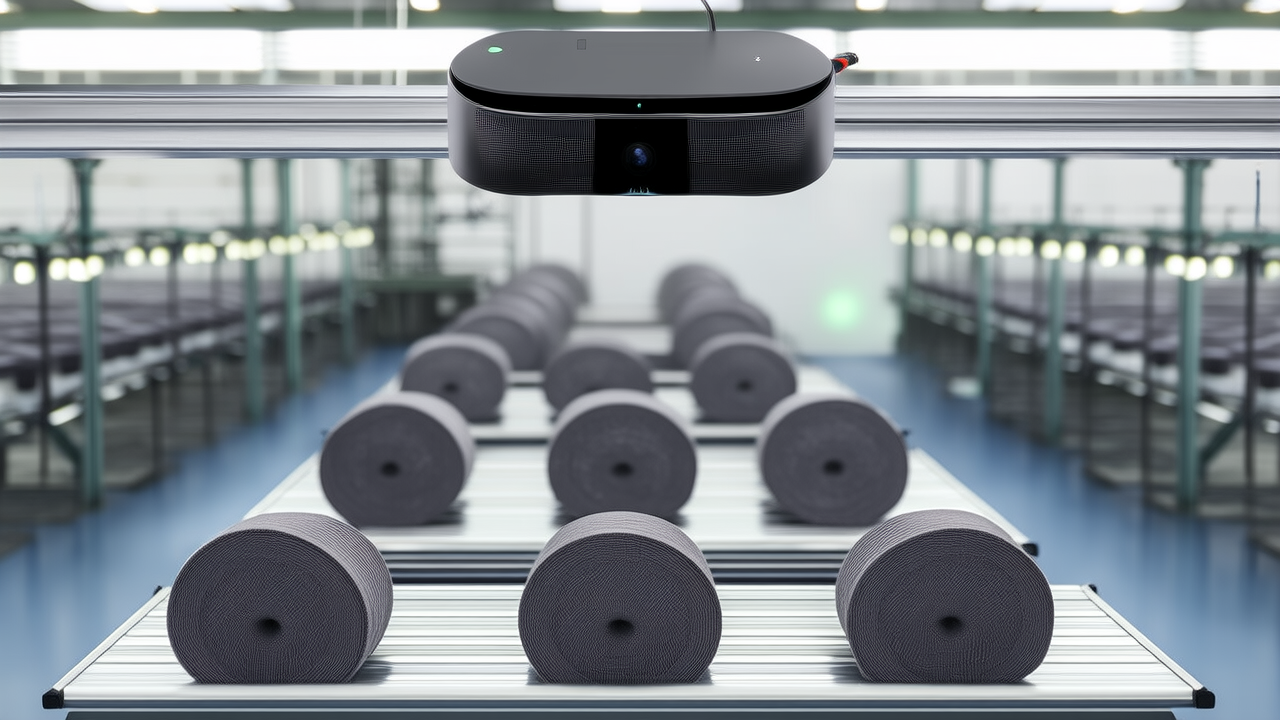
This conference in Keqiao was not merely a technology showcase; it was a collective calibration of the industry's digitalization pace.
The judgment from Yan Yan, Vice President of the China National Textile and Apparel Council (CNTAC), deserves close attention: the application of AI in textiles is moving 'from concept validation to large-scale deployment.' This is backed by hard data: traditional manual fabric inspection faces difficulties in recruitment and retention, fatigue-induced missed defects, and delayed quality feedback, causing hidden losses of millions of yuan annually for medium-sized fabric companies.
Three Tracks, One Core Thread
The three designated tracks—digital transformation of dyeing and finishing enterprises, AI-based fabric inspection technology, and full-process enterprise digital upgrade—may seem parallel, but they share a single core thread: using data to break down physical barriers from spinning to garments.
The digitalization of the dyeing and finishing process is the most representative. Long Fangsheng, General Manager of Zhejiang Meixinda Textile Printing and Dyeing Technology, shared the company's three-stage evolution path of 'shaping, soul-casting, and intelligence-enabling.' His core message is crucial for both buyers and factories: smart factories should not be viewed as cost centers but as order-creation centers. This means the ROI of digital investment should shift from 'how many people are saved' to 'how much more profit is generated.'
The TDSD low-carbon digital dyeing process from Hangzhou Huanyu Digital Technology provides compelling data: nearly 99% water savings, 33% carbon reduction, and 21% less chemical usage. If this 'print-and-dye' model is scaled, it will directly change the order-taking logic of dyeing mills—from 'large-batch standardization' to 'small-batch flexible response,' which is highly attractive to fast-fashion supply chains.
AI Fabric Inspection: Technology is Ready, Standards are Not
AI fabric inspection was the most debated topic at the conference. Representatives from Shanghai Kaiqian Intelligent Technology, Nantong Julian Digital Technology, and Keqiao Weaving and Dyeing Industrial Brain Operation Company delivered a nearly unanimous assessment: the technology itself is no longer the bottleneck; the real shortcoming is the lack of a unified industry-wide defect standard database.
Luo Yucheng, Deputy General Manager of the Keqiao Weaving and Dyeing Industrial Brain Operation Company, identified three major obstacles: difficulty in algorithm adaptation for complex fabrics, high false-positive rates in unstable production line environments, and prohibitive upfront costs for SMEs. The core issue is that every factory defines defects differently, making AI models non-reusable across plants and driving up development costs.
Hu Song, Director of the China Textile Information Center, proposed a five-step approach: 'diagnose the current situation, select scenarios, supplement data, run pilots, and expand capabilities.' This is essentially telling companies not to aim for a big bang but to start with the most painful scenario and the cleanest dataset.
What This Means for Buyers and Factories
For fabric buyers, the maturity of AI inspection will directly impact inspection efficiency and quality consistency. The industry is currently in a 'pilot adaptation' phase, meaning a dual-track system of manual plus AI inspection will be necessary in the short term. However, companies that can establish their own internal defect databases will gain a first-mover advantage in quality control.
For small and medium-sized textile factories, Hu Song's advice on a 'low-cost, quick-win' path is worth following: use low-code platforms to build lightweight digital management systems rather than immediately implementing full-scale ERP or MES. A case study shared by Wang Rong, CEO of Shaoxing Getakesi Light Textile Technology, shows that by using a low-code platform to achieve a full business process loop, small trading companies can start their digital transformation without adding an IT team.
Actionable Recommendations
For Buyers - Prioritize suppliers who have deployed AI inspection systems and can provide defect traceability reports; these factories typically offer higher consistency in quality control. - In inspection standard contracts, try to include a dual-track clause of 'AI-assisted inspection plus manual sampling' to reduce the risk of missed defects from traditional inspection.
For Small and Medium-Sized Factories - Don't blindly pursue full-process digitalization. Start with the most painful scenario in dyeing or inspection, using a 'small-cut application' to drive a 'large ecosystem transformation.' - Actively participate in the industry association's effort to build a defect standard database. This will be the most critical industry infrastructure in the next three years—early participation means securing a prime position in algorithm adaptation.
Chen Baojian, Deputy Director of the Textile Product Development Center, concluded with a call for 'enterprises to plan ahead and seize the first-mover advantage.' This is not mere rhetoric. When AI inspection moves from pilot to scale, companies that have already completed data accumulation will have the power to define industry standards.