
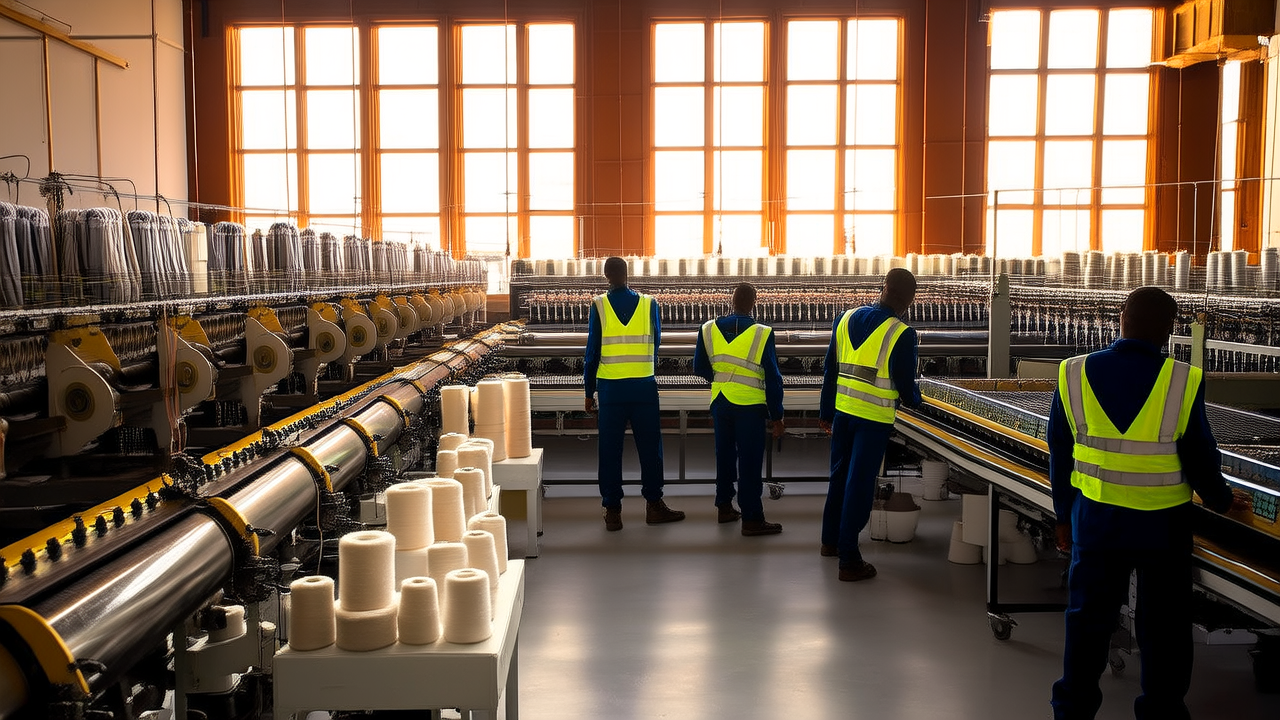
A Chinese textile company is shipping 80-count high-end yarns produced in Ethiopia directly to European buyers, passing through Djibouti port. This is not just another export order—it marks the moment when 'Made in Africa' enters the premium supply chain of European textile mills.
Background
Wuxi No.1 Cotton's Ethiopia factory has dispatched its first batch of high-count yarns to Europe. The shipment travels from the factory to Djibouti port and then directly to European customers, achieving a direct sales model from African production to European end-users. As a key project under China-Africa textile capacity cooperation, the factory has been optimizing its product mix and expanding high-count yarn capacity.
Ethiopia's geographic position is a strategic advantage—located at the crossroads of Europe, Africa, and the Middle East, it offers shorter logistics routes and faster response times to European markets compared to Asian manufacturing bases. This is the core logic behind the company's investment decision.
Industry Impact
This order carries multiple signals. First, it validates that African-made high-end yarns can pass European buyers' quality audits and supply chain compliance requirements. For a long time, African textile manufacturing was labeled as 'low-end and coarse-count.' But 80-count and above yarns are technology-intensive products requiring precision machinery and skilled operators. Wuxi No.1 Cotton's breakthrough proves that African factories are capable of producing high-value-added products.
Second, in terms of market expansion, the company has not only secured its first European direct order but also achieved bulk supply of 80-count yarns in Pakistan. This 'Europe plus South Asia' dual-market strategy reduces exposure to single-market volatility. Public data shows the company's Q1 export sales and volume both grew year-on-year, indicating that its overseas market strategy is delivering results.
More notably, Wuxi No.1 Cotton is leading the effort to build a complete textile supply chain in Ethiopia, establishing stable cooperation mechanisms with local enterprises. This means it is no longer an isolated factory but is creating a local ecosystem from yarn to fabric. For European procurement teams, such 'one-stop African supply' stability is more attractive than one-off orders.
Practical Recommendations
For Buyers - Verify quality consistency: Before placing initial orders, request third-party test reports for three consecutive batches, focusing on evenness and strength CV values. - Assess logistics advantage: Shipping from Ethiopia to Europe takes about 10-12 days, saving 7-10 days compared to Chinese ports—valuable for fast-fashion replenishment. - Check ESG compliance: European brands are tightening scrutiny on African origins; ask suppliers for SA8000 or ISO 14001 certifications.
For Exporters - Reposition Ethiopia's role: No longer view it as a 'low-cost alternative' but as a 'premium customization base' suitable for time-sensitive, mid-to-high-end European clients. - Invest in local quality control: Worker training cycles in African factories are longer; consider stationing Chinese technical supervisors to maintain process standards. - Leverage Agoa tariff benefits: If products are wholly manufactured in Ethiopia, exports to Europe may qualify for duty-free treatment—highlight this cost advantage to buyers.
Wuxi No.1 Cotton's move opens up a new horizon for Chinese textile firms: 'Produce in Africa, sell to Europe.' But the real challenge lies ahead—when more players enter Ethiopia, how to avoid commoditization and maintain the technical moat of high-count yarns? That will be the defining question for Africa's textile belt in the next three years.