
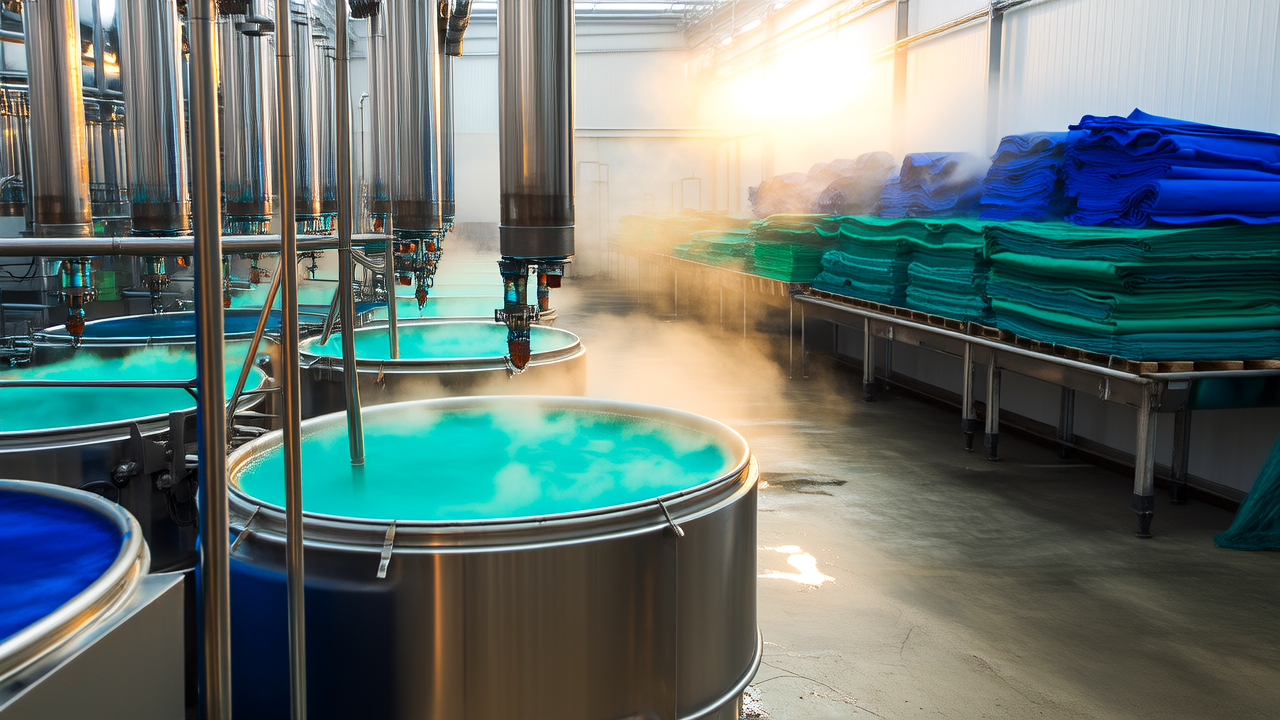
The textile dyeing and printing industry has long struggled with a structural disconnect: pollution control and carbon reduction operated in silos, with companies investing heavily in wastewater treatment while carbon accounting remained vague. In May 2026, the China Dyeing and Printing Association released six group standards to end this fragmentation. The core document, T/CDPA 001—2026 'Evaluation Specification for Synergistic Pollution and Carbon Reduction in Dyeing Enterprises', integrates pollutant reduction, energy saving, carbon emission cuts, and production efficiency into one assessment system for the first time. This means green transformation is no longer measured by a single metric but by a comprehensive scoring framework.
From Single-Point Control to Synergistic Evaluation
The six standards form an interlocking technical matrix. Beyond the evaluation specification, the other five focus on process optimization, resource recycling, carbon accounting, and clean production management. The association deliberately avoided a one-size-fits-all approach, balancing alignment with national dual-carbon policies and applicability for both large and small factories. For top-tier enterprises generating billions in annual revenue, the standards provide authoritative support for green supply chain certification and low-carbon credentials. For small and medium-sized firms, the detailed evaluation criteria directly pinpoint environmental weak spots, making the direction of technical upgrades quantifiable.
Industry data shows that the dyeing sector accounts for about 15% of total textile industry energy consumption and over 70% of wastewater discharge. Previously, companies often installed end-of-pipe treatment facilities just to pass inspections, with little incentive for front-end process improvements. The new standards' core principle of 'synergistic efficiency' means pollution control and carbon reduction can no longer be accounted for separately—a failure to reduce energy consumption or carbon emissions will drag down the overall evaluation score. This mechanism fundamentally alters the cost-benefit calculus for enterprises.
Industrial Impact: Capacity Shakeout and Technology Upgrade
The implementation of these standards will first hit high-water-consumption, high-energy-consumption outdated capacity. Technologies like low-liquor-ratio dyeing, waste heat recovery, and water recycling have matured but lacked a unified evaluation framework to justify investment. A waste heat recovery system costs hundreds of thousands of yuan; without standard recognition of its carbon reduction contribution, the return on investment remained uncertain. By incorporating these technologies into scoring dimensions, the economic case becomes clear. Industry analysts expect that small and medium dyeing enterprises will increase technology upgrade spending by over 20% in the next two years, while a batch of grey-area workshops will accelerate their exit.
From a supply chain perspective, the standard upgrade will push upstream dye and auxiliary suppliers to adjust their product mix. Demand for green chemicals—those with low COD and low AOX—will rise sharply, and chemical companies offering such products will command a price premium. Meanwhile, downstream brands can use the standard evaluation scores to screen green suppliers, providing compliance backing for export to markets like the EU with high environmental thresholds.