
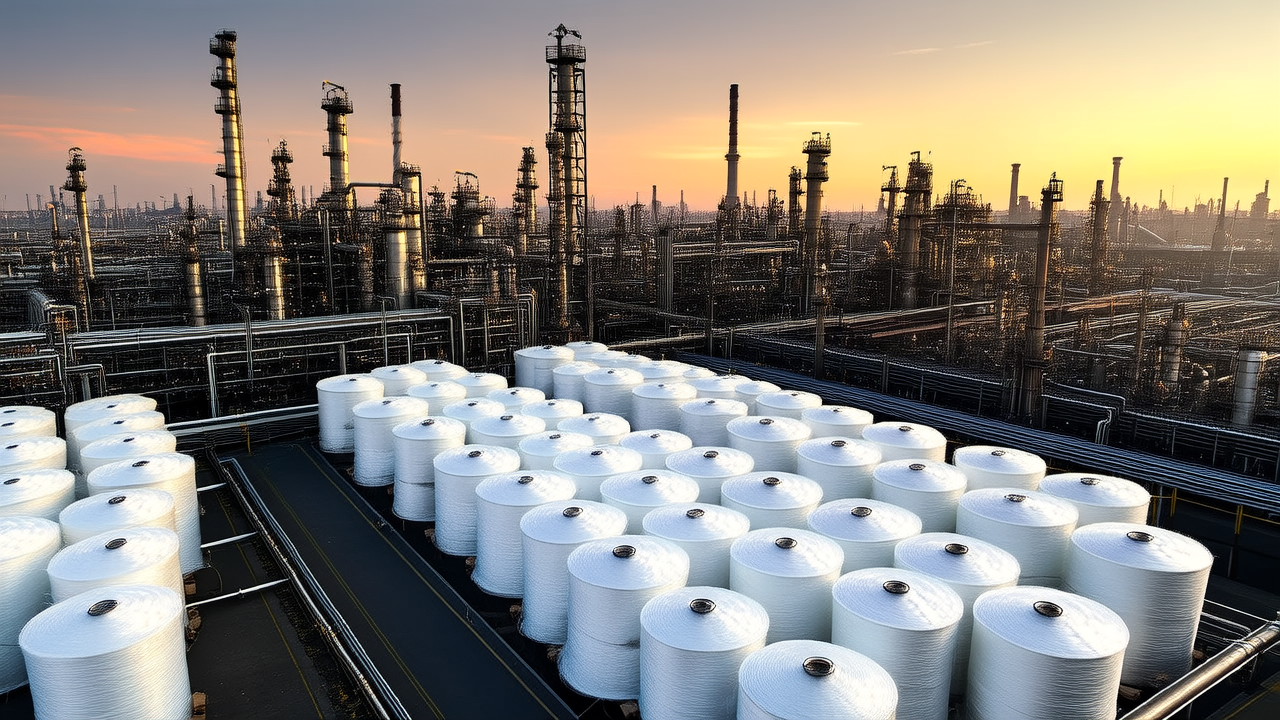
The international crude oil market is undergoing a structural shift. After formally exiting OPEC, the UAE has fully unleashed its production capacity with low-cost crude, tilting the global oil supply-demand balance. This change not only disrupts the traditional pricing system but also transmits a clear cost dividend window to the textile chemical industry through the industrial chain.
Cost Transmission: Chemical Fiber Prices Ease
The UAE's current crude oil daily production capacity has reached 4.85 million barrels, with plans to exceed 5 million barrels by 2027 and a medium-to-long-term target of 6 million barrels. After exiting OPEC, it has shed the quota constraints that long locked its output at 3-3.5 million barrels per day, freeing up more than a quarter of high-quality idle capacity. A flood of low-cost crude into the spot market has directly pushed down international oil prices.
As a result, domestic chemical fiber raw material prices have been declining steadily. Prices for polyester filament, staple fiber, and polyester chips have dropped, directly easing the operational difficulties of weaving, home textile, and garment processing enterprises that have long faced high raw material costs, high energy pressure, and narrow profit margins. With the traditional peak season for textiles in the second half of the year approaching, companies can now adjust product pricing more flexibly and seize market orders.
However, the price decline driven by low-cost crude is not linear. A recent Goldman Sachs report indicates that global oil inventories are approaching eight-year lows, with uneven drawdown rates and regional imbalances. This means that if geopolitical or supply chain disruptions occur, oil prices could rebound quickly, making the cost dividend window uncertain.
African Market: Opportunities from Energy Restructuring
The UAE's large-scale influx of low-cost crude into the African market is one of the most profound impacts of this event on textile foreign trade. Africa is both a major global oil-producing region and a core export destination for Chinese textile fabrics, home textiles, and garments.
Previously, Africa's local crude oil and refining industries supported the supply of basic textile raw materials. However, most African oil-producing countries suffer from backward refining technology and high extraction costs, making their local raw material prices consistently higher than international levels. As UAE low-cost crude continues to flow in, the export and market space for African local crude has been squeezed significantly. Local oil and gas companies see shrinking profits, refining capacity utilization falls, and the original order of the regional textile raw material supply chain is disrupted.
This presents a dual shift for Chinese textile foreign trade enterprises. In the short term, local African chemical fiber raw material supply may tighten, creating substitution space for Chinese polyester, viscose, and other products. In the medium to long term, if African refining industries shrink due to cost disadvantages, the region's dependence on Chinese textile semi-finished and finished products may increase further. However, companies must also watch for potential foreign exchange constraints in some African countries due to falling energy revenues, which could affect import payment capacity.
Practical Recommendations
For Purchasers - Current polyester filament and chip prices are at cyclical lows; consider moderately increasing raw material inventories to lock in production costs for the next 2-3 months. - Closely monitor international oil prices and subsequent OPEC reactions, especially whether Saudi Arabia adjusts its production cut strategy, to avoid sudden reversals of the cost dividend. - Exercise caution with African orders, prioritizing cooperation with clients from countries with stable foreign exchange reserves or using secure settlement methods like letters of credit.
For Foreign Trade Enterprises - Seize the gap in African local chemical fiber raw material supply by actively promoting Chinese polyester, nylon, and other advantageous products to capture substitution market share. - Monitor African refining project developments; if local energy cost increases accelerate the deployment of alternative energy sources like photovoltaics, consider promoting energy-efficient textile equipment. - Establish an oil-price-to-chemical-fiber-price linkage model and include floating clauses in external quotations to hedge against raw material price volatility risks.
The UAE's exit from OPEC is a landmark event in the 2026 international energy market. Its impact on the textile industry chain is expanding from the cost side to the trade structure side. Companies should look beyond short-term price fluctuations and plan from the perspectives of supply chain security and market structure reshaping to seize the initiative amidst change.