
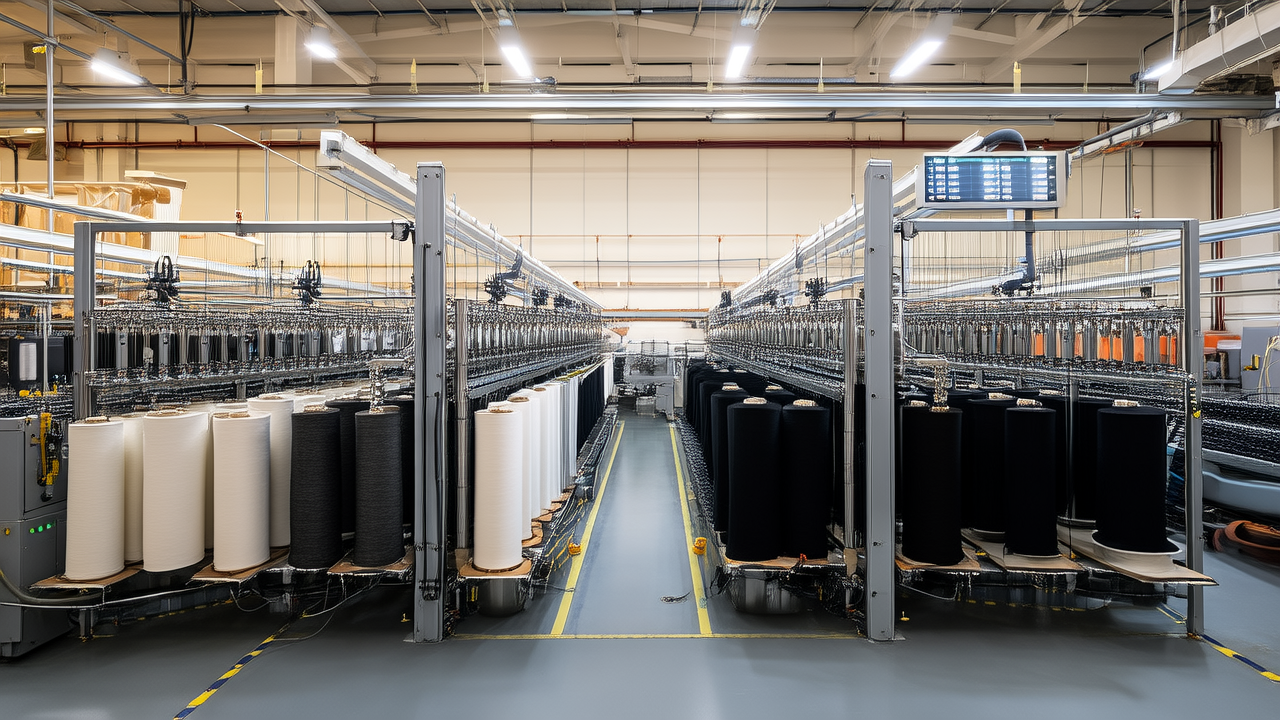
One figure alone is enough to make the entire dyeing and printing industry take notice: nearly 99% water savings, 33% carbon reduction, and 21% less chemical usage. At the 2026 Textile Industry Digitalization Conference, Hangzhou Huanyu Digital Smart Technology Co., Ltd. unveiled its TDSD® (Textile Digital Smart Dyeing) low-carbon digital dyeing process, marking a technological leap from traditional water-bath dyeing to 'spray-and-dye' production. This is not just a process innovation; it means the most water-intensive and polluting link in the textile chain now has a viable green alternative.
Background
On May 7, the 2026 Textile Industry Digitalization Conference was held in Keqiao, Shaoxing, under the theme 'Smart Link Textile Capital, Digital Build Future – Constructing New Quality Productivity for the Textile Industry.' The conference was guided by the China National Textile and Apparel Council (CNTAC) and jointly promoted by local government and multiple industry organizations. Key attendees included Yan Yan, Vice Chairman of the International Textile Manufacturers Federation and Vice President of CNTAC; Sun Weigang, Deputy Secretary of the Party Working Committee of China Textile City; and Hu Song, Director of the China Textile Information Center. The conference focused on three core tracks: digital and intelligent transformation of dyeing and printing enterprises, AI-powered fabric inspection technology, and full-process digital upgrading of enterprises.
In her speech, Yan Yan outlined three major directions for textile digitalization during the '15th Five-Year Plan' period: deeply promoting AI implementation and building a collaborative system of large industry models and small vertical models; breaking down data silos across the entire chain to enable intelligent decision-making; and integrating green manufacturing to establish a full-industry-chain carbon footprint tracking model. These three directions essentially frame the top-level architecture for textile digitalization over the next five years.
Industry Impact
AI fabric inspection emerged as one of the most closely watched application scenarios at the conference. Traditional manual inspection faces systemic pain points such as labor shortages, high miss rates, and delayed feedback. AI inspection technology has moved from labs to factories. Shanghai Kaiquan Intelligent Technology Co., Ltd. introduced a 'teachable' self-learning AI vision system with integrated hardware and software that connects to enterprise production management systems. Nantong Julian Digital Technology Co., Ltd. developed a lightweight solution covering online defect warning, warp/weft density monitoring, and production anomaly identification, based on actual factory needs.
Notably, Luo Yucheng, Deputy General Manager of Shaoxing Keqiao Weaving and Dyeing Industrial Brain Operation Co., Ltd., pointed out industry bottlenecks: algorithm adaptation for complex fabrics, environmental instability, and high implementation costs for SMEs. This indicates that AI fabric inspection is still in a 'pilot and adaptation' stage, far from large-scale replication. Chen Baojian, Deputy Director of the Textile Product Development Center, suggested in his summary that an industry-standard defect database should be established, which would be a critical infrastructure for AI inspection to move from single-point breakthroughs to full-chain applications.
On the topic of digital transformation paths for SMEs versus large enterprises, the conference provided a clear stratified strategy. Hu Song, Director of the China Textile Information Center, proposed a 'five-step digitalization method': diagnose current status, select scenarios, supplement data, run pilots, and expand capabilities. SMEs should take a low-cost, quick-impact route, starting with the most painful, data-clear, and measurable scenarios, using 'small-cut applications' to drive 'large ecosystem transformation.' Large enterprises, on the other hand, need to shift from system construction to data ecosystem leadership, building industry-level intelligent agents.
Long Fangsheng, General Manager of Zhejiang Meixinda Textile Printing and Dyeing Technology Co., Ltd., shared the company's 'shaping, soul-casting, and intelligence-awakening' three-stage evolution. He proposed a disruptive view: a smart factory is not a cost center but an order creation center. This judgment offers direct reference value for companies hesitating to invest in digital transformation – the ROI of digitalization should not only count 'cost savings' but also 'revenue generation.'