
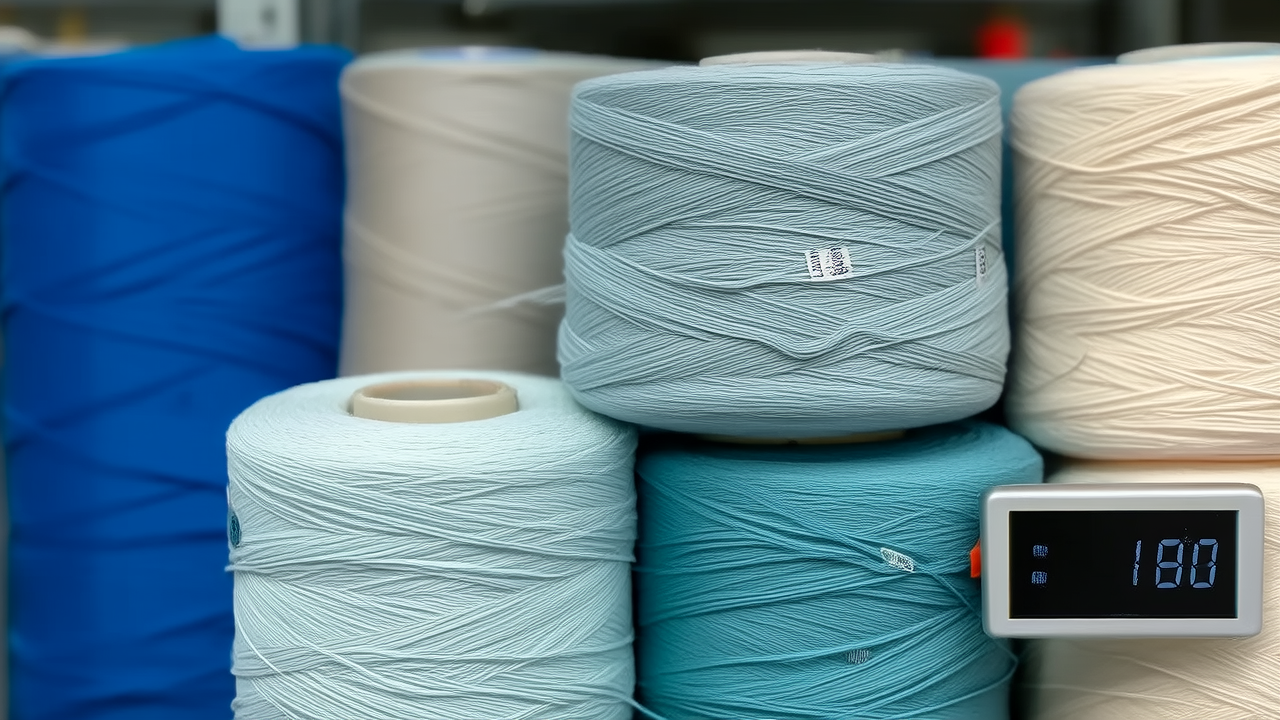
The latest price quotes from the Wangjiangjing polyester filament market reveal a rare phenomenon: since May 10, the ex-warehouse prices of dozens of specifications across FDY, POY, and DTY have remained completely unchanged. This across-the-board stagnation is uncommon in the polyester filament market, typically indicating a delicate balance between upstream and downstream forces.
The Pincer Movement of Upstream Costs and Downstream Demand
The price deadlock is driven by two factors. Upstream, polyester raw materials have been fluctuating recently without offering a clear directional signal, leaving filament producers without a basis for price adjustments. Simultaneously, downstream weaving mills show clear divergence in procurement: FDY 75D/144F, favored for lightweight fabrics, sees decent sales, while DTY 150D/48F faces notably weak buying interest, reflecting a shift in end-order structures from conventional to differentiated varieties.
Looking at specific data, FDY 50D/24F prices are stable at 9,900-10,100 yuan/ton, while DTY 150D/48F remains at 10,100-10,200 yuan/ton. POY 150D/48F is quoted at 8,800 yuan/ton, forming a reasonable price gradient with FDY and DTY. This overall flatness represents a rational market digestion after previous volatility.
Subtle Shifts in Industrial Belt Procurement Rhythm
As a key polyester filament distribution hub, Wangjiangjing's price signals serve as a bellwether for the Jiangsu-Zhejiang weaving cluster. The current stalemate suggests that weaving mills are no longer blindly chasing price movements but are instead making precise replenishments based on their own order cycles. The relatively strong sales of FDY 75D/144F imply sustained demand for fine-denier yarns used in spring/summer women's apparel, while the weakness of DTY 150D/48F indicates a contraction in the use of conventional polyester DTY in linings and low-end garment fabrics.
This structural divergence warrants attention from buyers. If upstream polyester raw materials break downward after their recent fluctuations, the current price plateau could quickly turn into a downward channel. Conversely, if a concentrated restocking wave emerges from the demand side, the stagnation could become a staging ground for the next price increase.
Outlook: Adjustment More Likely Than Breakout
Based on industry public data, polyester filament inventories have accumulated recently, while downstream loom operating rates have not shown a significant recovery. Against this backdrop, a breakdown of the stagnation pattern is more likely to occur through a slight price decline. For foreign trade enterprises, the current combination of exchange rate volatility and overseas order uncertainty means they should avoid increasing inventory exposure due to short-term price stability.