
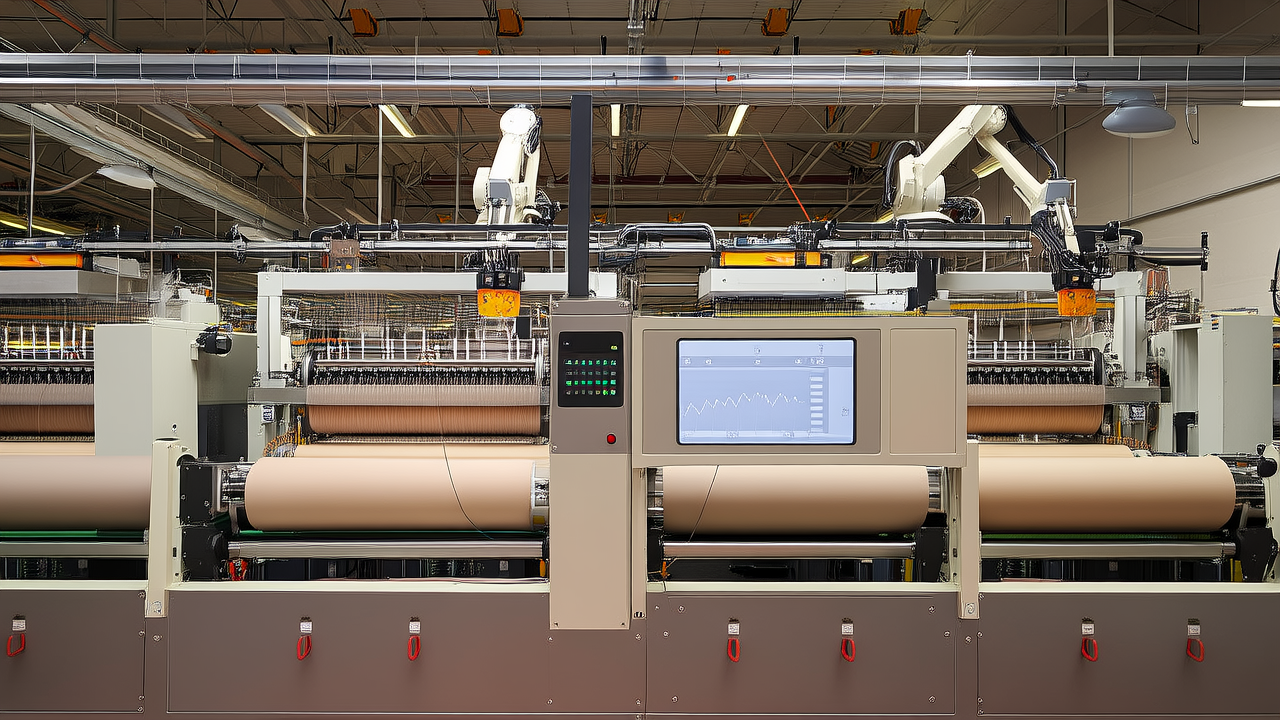
The implementation of the Industrial Internet in the textile and garment industry is moving from 'pilot demonstrations' to 'large-scale application.' Among the 2025 Industrial Internet 'Chain-Network Synergy' exemplary cases recently publicized by the Ministry of Industry and Information Technology, four projects from the textile and garment sector were selected, covering AI vertical large models, 5G smart manufacturing, full-chain digital collaboration, and intelligent garment services. This result signals that digital transformation in textiles has moved beyond point-specific improvements and is now penetrating deep into upstream and downstream supply chain coordination.
Cases Cover Four Technical Directions, Targeting Industry Pain Points
The four selected cases represent distinct technological paths. The AI large model focuses on the entire textile value chain, aiming to optimize decision-making from design to production through algorithms. The 5G-driven smart manufacturing solution targets real-time collaboration and flexible production on the shop floor. The full-chain digital collaboration system emphasizes platform integration of supply chains, inventory, and logistics. The intelligent garment solution focuses on service-side digital upgrades.
According to the Ministry's selection criteria, key application scenarios included production unit simulation, equipment collaboration, flexible manufacturing, process compliance verification, demand forecasting and inventory optimization, quality traceability, and 3D virtual fitting. These scenarios all address long-standing industry pain points: inventory overhang, slow response times, quality control challenges, and insufficient agility for small-batch, quick-turn orders. The selection of these four cases confirms that these technologies have proven replicable and economically viable in real-world applications.
From Point-Specific Upgrades to 'Chain Transformation,' the Logic of Collaboration Has Changed
In the past, digitalization in textiles was largely confined to single-factory automation or ERP system deployments. However, the 'Chain-Network Synergy' case selection criteria explicitly require 'sharing of upstream and downstream resources and factor connectivity,' emphasizing 'chain transformation benefits.' This reflects a policy shift: the value of the Industrial Internet lies not in efficiency gains for individual companies, but in linking supply chains, innovation chains, and service chains, allowing data to flow between upstream and downstream players.
For example, the AI large model's applications extend beyond design pattern generation to fabric matching, process parameter optimization, and order scheduling, thereby enabling collaboration between weaving, dyeing, and garment factories. 5G technology reduces communication latency within factories to milliseconds, supporting remote quality inspections and predictive equipment maintenance, which reduces delivery delays caused by machine breakdowns.
For textile enterprises, this means the return on investment for digital transformation is changing. Previously, building proprietary digital systems was costly and slow to yield results. Through platform-based 'chain-network synergy,' small and medium-sized enterprises can now access industry-level cloud platforms at lower costs, sharing orders, capacity, and logistics resources. The Ministry's notice explicitly calls for 'accelerating SME cloud adoption and network utilization.'
Impact on Buyers and Foreign Trade Companies
The promotion of these four cases will directly reshape supply chain operations in the textile and garment industry. Buyers will be able to track order progress in real-time, view factory capacity utilization, and confirm patterns via 3D virtual fitting, reducing sampling cycles and communication costs. Foreign trade companies can use full-chain collaboration platforms to more accurately match overseas orders with domestic capacity, lowering default risks caused by information asymmetry.
For Buyers - Prioritize suppliers that are connected to Industrial Internet platforms; these factories typically offer more transparent production data and more stable delivery performance. - Leverage 3D virtual fitting and AI design tools to move sampling online, shortening new product development cycles to 3-5 days. - Utilize platform inventory-sharing features to reduce safety stock levels and free up working capital.
For Foreign Trade Companies - Assess which links in your supply chain can be integrated into industry-level collaboration platforms, prioritizing digital blind spots in order tracking and quality traceability. - Establish long-term partnerships with factories equipped with 5G or AI capabilities; these factories are more flexible in handling small-batch, multi-variety orders. - Use platform demand forecasting algorithms to adjust procurement plans in advance, mitigating inventory risks from shipping cycle volatility.
The Path to Industrial Upgrading Driven by New Quality Productive Forces
The Ministry positions this case collection as 'promoting the large-scale application and popularization of the Industrial Internet' and explicitly aims to 'empower traditional industries with new quality productive forces.' For a labor-intensive industry like textiles, the core of new quality productive forces is not to eliminate labor, but to reshape human-machine collaboration through data and algorithms. The demonstration effect of these four cases will accelerate the industry's transformation from 'manufacturing' to 'smart manufacturing.'
Notably, the selected cases cover the entire chain from technological innovation to service upgrades, indicating that policymakers have formed a clear roadmap for industrial upgrading: AI addresses decision-making efficiency, 5G addresses connectivity efficiency, platforms address collaboration efficiency, and services address value realization efficiency. Only by combining these four elements can the goals of 'high-end, intelligent, and green' development be truly achieved.
The window for digital transformation in the textile and garment industry is now open. For companies, the cost of waiting is rising—when competitors have already reduced operating costs by over 15% through chain-network synergy, the old model of relying solely on manual management will find it increasingly difficult to cope with market volatility.