
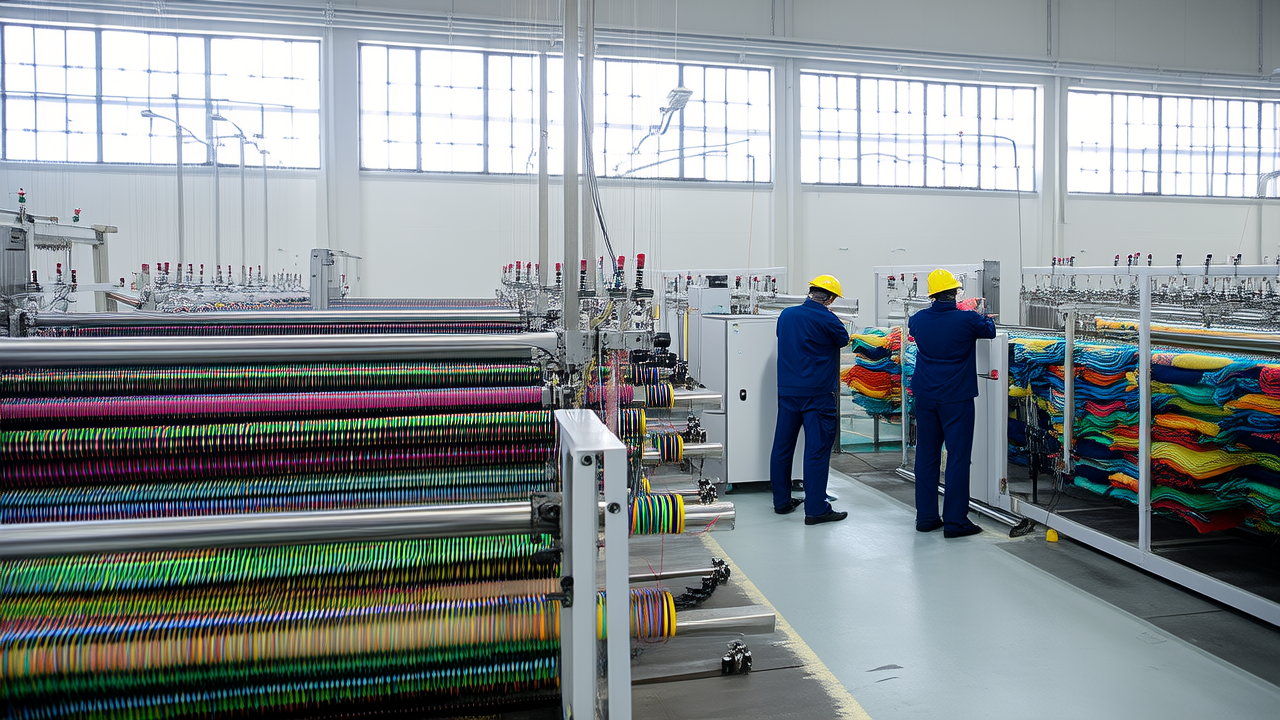
In 2025, Zhejiang's textile industry achieved 1.12 trillion yuan in revenue and 95.331 billion USD in exports, maintaining its national lead. But the anxiety of a frontrunner runs deep: when scale dividends peak, where does the next move lie?
Hard Data Behind Industrial Shifts
The 1.12 trillion yuan revenue accounts for roughly one-seventh of Zhejiang's GDP. China Textile City's annual turnover exceeded 440 billion yuan, connecting over 200 countries and regions. These figures show Zhejiang textiles are no longer just a manufacturing base but an irreplaceable hub in the global supply chain.
However, scale does not equal profit. Structural contradictions are intensifying: upstream spinning and weaving segments face shrinking margins, with SMEs under severe survival pressure. The Zhejiang Provincial Department of Economy and Information Technology has officially included textiles in the '415X' advanced manufacturing cluster system, signaling policy resources will tilt toward innovation, digital intelligence, and green transformation rather than simple capacity expansion.
Three Breakthrough Directions Under Government-Enterprise Synergy
At the Zhejiang Textile Industry High-Quality Development Sharing Conference held on May 8, 2026, in Keqiao, Shaoxing, stakeholders outlined three clear paths.
First, innovation-driven material upgrades. Breakthroughs in functional masterbatches and recycled fibers are becoming core weapons for differentiation. For instance, Zhejiang Jincai New Material's exploration in functional masterbatches directly addresses downstream demand for functionality and environmental performance.
Second, digital transformation moves from concept to practice. Shaoxing Huanxi Smart Technology's 'Wave of Intelligent Change and Battle Map' is based on real factory renovation cases, offering low-cost paths for SMEs.
Third, green transformation and branding advance in tandem. Practices by Zhejiang Guxian Dao Green Fiber and Jia Ren New Materials show that circular economy and green manufacturing are not just compliance requirements but keys to opening high-end European and American markets.
Facing Industry Pain Points Head-On
The most striking session was Huafu Fashion Chairman Sun Weiting's candid Q&A. When asked 'How can spinning and weaving firms survive?', he replied bluntly: 'Profit more in H1, lose less in H2, and guard cash flow and profit margins all year.'
This reflects a harsh reality: in an oversupplied, zero-sum competition phase, the logic of trading scale for survival has failed. Sun further advised capable firms to prioritize coordinated expansion into Western developed markets rather than adding capacity at home. This aligns with customs data: Zhejiang's textile exports of 95.331 billion USD in 2025 confirm that overseas markets remain the main profit source.
New Mechanisms for Industry-Academia Integration
During the conference, the Zhejiang Textile Industry Association signed a strategic agreement with Textile & Apparel Weekly to build industry content IP and strengthen think-tank functions. Meanwhile, the Zhejiang Textile Engineering Society and the association jointly established six professional committees covering fiber materials, spinning technology, weaving, home textiles, textile machinery and smart manufacturing, and sustainable development.
This means fragmented research resources will now precisely match industry needs. For fabric buyers and factories, the immediate benefit is faster conversion of lab technologies into mass-producible products, and quicker solutions to technical bottlenecks.