
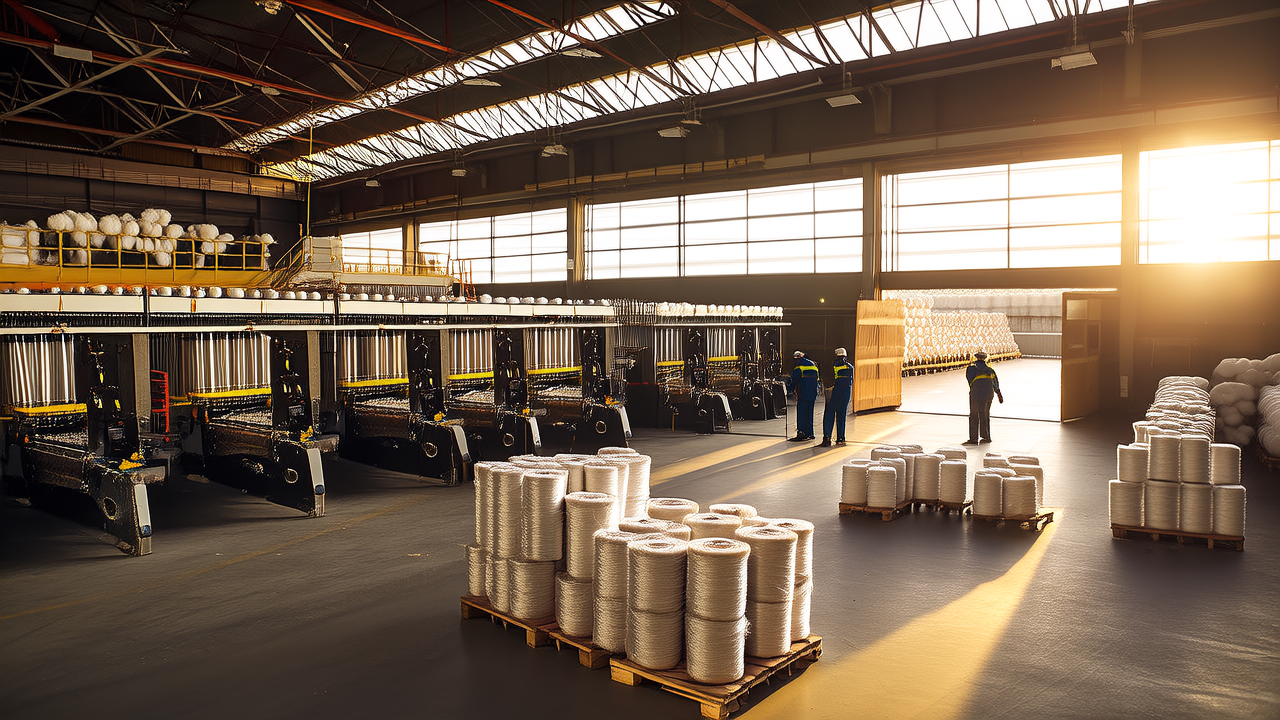
The narrative of China's textile industry shifting production overseas is evolving from 'low-cost manufacturing' to 'high-end supply chain integration.' The latest evidence comes from Wuxi No.1 Cotton Mill's Ethiopia plant, which has shipped its first batch of premium yarn to Europe via Djibouti. This is more than a single company's export milestone—it signals that African-made yarn has entered the European procurement system at a premium tier.
The High-End Turning Point for African Textiles
For years, African textiles were branded as low-count and low-value, but Wuxi No.1 Cotton Mill is challenging that perception. The Ethiopia plant has been expanding high-count yarn capacity, and this European shipment consists of premium-grade products. Earlier this year, the plant also supplied 80-count yarn to Pakistan on a batch basis. High-count yarn demands strict raw material quality, spinning precision, and humidity control—all of which the plant has proven capable of managing in Africa.
Geographically, Ethiopia sits at the crossroads of Europe, the Middle East, and Africa, with Djibouti port offering direct sea routes to Europe that rival the transit times of some Southeast Asian routes. This means African premium yarn can compete on delivery speed, not just tariff advantages.
Data Validation: Structural Shift Behind Export Growth
Wuxi No.1 Cotton Mill reported double-digit year-on-year growth in both export sales and volume in Q1. Against a backdrop of weak European and U.S. demand and global textile trade contraction, this growth is notable. Two factors are at play: first, African-made yarn is substituting for some Chinese high-end yarn exports; second, the company has moved customer engagement upstream, securing orders before they are formally placed.
More importantly, the company has built a complete textile supply chain locally, from raw material sourcing to spinning and trade, with stable cooperation mechanisms with local enterprises. This is not a simple 'processing with imported materials' model—it is a closed-loop system that reduces dependence on any single market.
Implications for Industrial Clusters
Wuxi No.1 Cotton Mill's move offers a direct reference for Chinese textile clusters—especially in Wuxi, Nantong, and Shaoxing, which specialize in high-count yarn and premium fabrics. Previously, overcapacity in domestic high-count yarn led to price wars. If African plants can stably produce 80-count and above, domestic mills can shift focus to even finer counts and customized small-lot orders, creating a 'R&D in China, mass production in Africa' dual-track model.
For European buyers, African yarn diversifies supply chains and reduces risk. Historically, European high-end fabric makers relied heavily on Chinese and Turkish high-count yarn, exposing them to geopolitical and logistics disruptions. The Ethiopia plant offers a third option—one that benefits from African Continental Free Trade Area tariff preferences.