
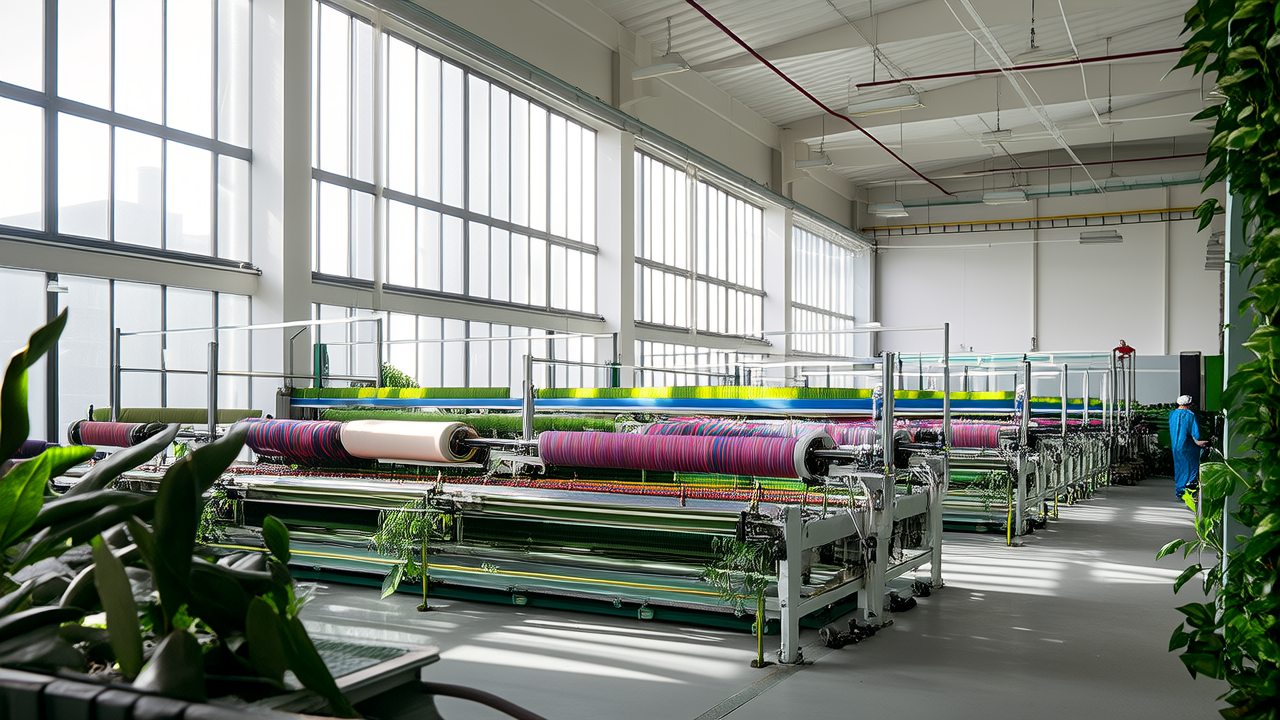
A chemical fiber company with over 2,000 Party members is turning 'a drop of oil' into 'a piece of fabric' and plans to complete a zero-carbon park by 2025. This is not an isolated case. At a closed-door industry meeting in late April, 15 textile companies disclosed concrete pathways for transforming Party building into technological breakthroughs and green commitments.
Party Building and R&D: From Organizational Power to Innovation
When Party building evolves from a guiding principle in documents into a daily management tool in R&D labs, measurable changes in innovation efficiency emerge. The data from Sanyuan Holding Group provides the most direct evidence: its 13 subsidiaries have established Party branches simultaneously, with management taking the lead in joining the Party, resulting in a cumulative total of 189 invention patents. Among these, an industrial wastewater recycling project has been promoted by the Ministry of Industry and Information Technology.
What does this mean? Against the backdrop of shrinking profit margins in the textile industry, Party building is no longer a mere ideological activity but an organizational lever used by companies to reduce internal coordination costs and concentrate resources on overcoming technical bottlenecks. The practice of Hengshen Holding Group corroborates this—this company, with a complete 'drop of oil to piece of fabric' industrial chain, has integrated renewable energy sources like wind and solar into its production system through Party organization mobilization, accelerating the realization of a zero-carbon park.
Green Transformation Driven by Party Building
The case of Shumei Knitting is even more representative. This company has invested in a billion-level 'future factory,' setting zero-carbon and intelligence as core indicators. Its chairman explicitly stated at the meeting that Party building is the 'backbone' for凝聚 talent and promoting public welfare. From an industry perspective, this model is changing the traditional 'high energy consumption, high emission' label of dyeing and finishing enterprises.
Xingwu Worsted's intelligent dye delivery system and full-process digital control system represent another facet of Party building empowering green production. Through Party organization-driven company-wide technical transformation, this enterprise has set a benchmark in the worsted printing and dyeing sector. Notably, the commonality among these projects is that they were achieved through internal organizational mobilization rather than external compulsion.
Technological Breakthroughs: Micro-Foundation for Catching Up to Leading
The macro narrative of 'following, running alongside, to leading' finds its micro-level footing. Shepherd Clothing's self-developed NAO virtual weaving technology shortens the traditional sampling cycle from weeks to days; Sande Textile has broken through wool windproof and waterproof technologies, filling a performance gap in high-end woolen fabrics; Dymatic Chemicals has even extended its reach to cutting-edge fields like quantum programming.
These breakthroughs are not accidental. Shixiang Bio's differentiated path in vortex spinning and air-jet spinning shows that when companies combine Party building with R&D management, they are more likely to find growth space beyond the entrenched perception of 'market saturation.' The case of Taiji Stone, which transformed from a trader into a new materials brand and is pursuing FDA certification, illustrates the role of Party building in fostering long-term strategic focus.
The '15th Five-Year' Landing Point for Great Power Textiles
A judgment from Yan Yan, Vice President of the China National Textile and Apparel Council, is noteworthy: the textile industry is a livelihood industry for common prosperity and an advantageous industry for domestic and international integration. This means that as the '15th Five-Year Plan' approaches, the industry must not only lead technologically but also achieve breakthroughs in social responsibility and global supply chain discourse.
The actions of Xingmao Zhishang, which collaborates with international luxury brands and uses nano-coating and digital fabric labs to seize fashion discourse, and Youngor Woolen, which has conquered green dyeing and washable fabric technologies while pursuing a 'small capacity, high value-added' route, all point in the same direction—China's textile industry is shifting from 'scale-driven' to 'value-driven.'