
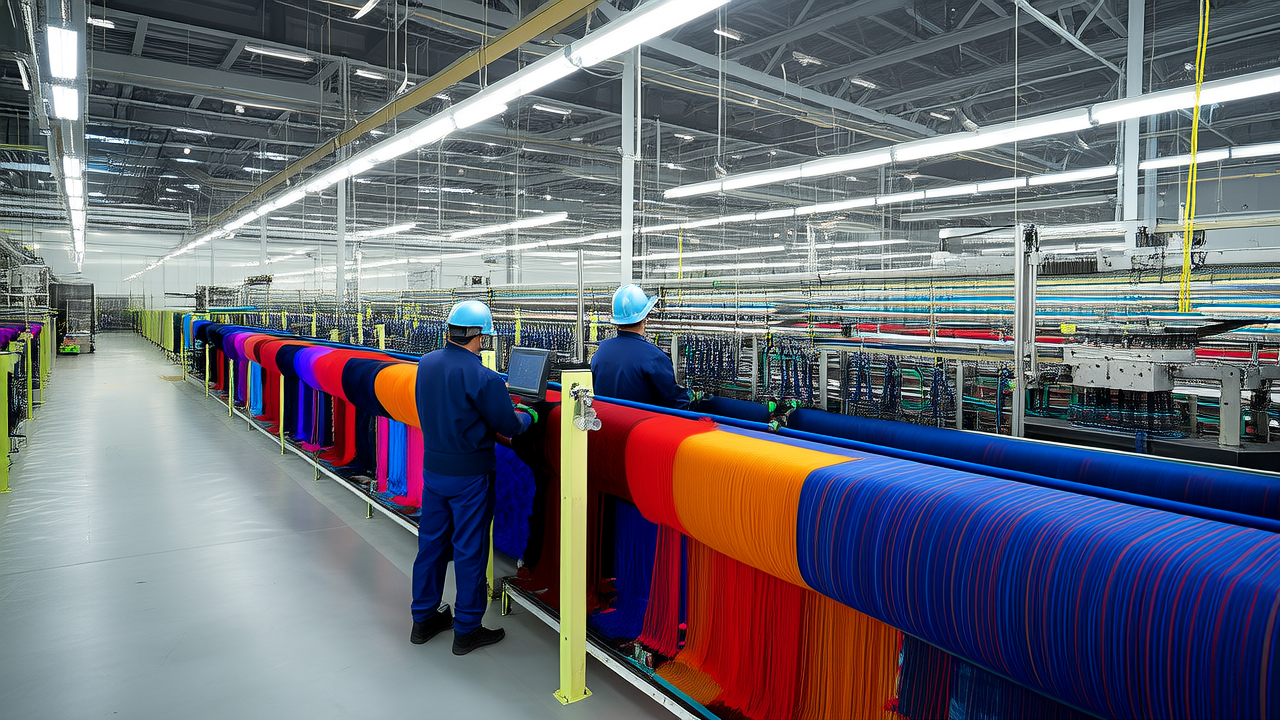
Zhejiang's textile industry delivered an impressive performance in 2025: above-scale enterprises achieved operating revenue of 1.12 trillion yuan and exports of 95.331 billion USD, maintaining the national lead. This data not only underscores the sector's role as a 'ballast stone' for Zhejiang's economy but also reflects its resilience amid complex external conditions. However, standing on the high base of 1.12 trillion, the core challenge is how to transition from 'leading' to 'leading with high quality.'
Government-Enterprise Synergy: From 'Ballast Stone' to 'Co-Designer'
On May 8, 2026, the Zhejiang Textile Industry High-Quality Development Sharing Conference was held in Keqiao, Shaoxing, concurrent with the Keqiao Spring Textile Expo. Officials from the Zhejiang Provincial Department of Economy and Information Technology and the Provincial Development and Reform Commission attended, signaling a clear policy direction: the textile industry has been included in the '415X' advanced manufacturing cluster for key cultivation. This means the government role is shifting from a traditional 'supporter' to a 'co-designer' of industrial upgrading.
The urgency of government-enterprise synergy stems from the industry's current phase. Behind the 1.12 trillion revenue lies the reality of narrowing profit margins and intensifying homogeneous competition. Zhao Jing, Deputy Director of the Consumer Goods Division of the Provincial Department of Economy and Information Technology, emphasized at the conference that innovation-driven, digital empowerment, green transformation, and brand leadership are the four key levers for coordinated efforts in the next stage. These four are not parallel options but a progressive chain—without digital transformation, green transition lacks efficiency; without brand premium, innovation investment becomes unsustainable.
Industrial Hub: Keqiao's 'World-Class' Ambition
Keqiao China Textile City, as the world's largest textile distribution center, achieved a turnover of over 440 billion yuan in 2025, connecting with more than 200 countries and regions. This hub is being entrusted with a higher mission: transitioning from a 'trading center' to a trinity of 'world-class industrial base, world-class market, and world-class sci-tech innovation platform.'
For buyers, this means Keqiao will no longer be just a place to 'find goods,' but will become a core node for trend release, standard setting, and technology incubation. Sun Weigang, Deputy Secretary of the Party Working Committee of the Textile City, pointed out at the meeting that market prosperity is rooted in industrial progress, and the future of the Textile City is closely tied to the high-quality development of the entire industry. This judgment reflects the increasingly close symbiotic relationship between industrial clusters and professional markets—the market provides order feedback for factories, and factories provide product innovation for the market, each amplifying the other.
Digital and Green: 'Twin Engines' and 'Hard Constraints' for Transformation
At the meeting, Shaoxing Huanxi Smart Technology Co., Ltd. shared the cutting-edge trends and implementation paths of digital transformation in the textile industry. Digitalization is no longer an 'option' but a 'must-pass' for survival. From single-machine automation to factory-wide digitalization and then to supply chain collaborative intelligence, each stage corresponds to different input-output ratios. For SMEs, blindly pursuing 'dark factories' is unrealistic; a more pragmatic path is to start with digital management of production processes and gradually accumulate data assets.
Meanwhile, green manufacturing was repeatedly emphasized. Cases from Zhejiang Jiaren New Materials and Zhejiang Guxiandao Green Fiber showed that circular recycling and low-carbon processes are shifting from 'cost burdens' to 'competitive barriers.' Major markets like the EU are imposing increasingly stringent requirements for traceability of textile carbon footprints, and green certification will become an 'entry threshold' for future exports, not a bonus.
Facing Pain Points: 'Survival Rules' from Entrepreneur Q&A
The specially arranged 'Entrepreneur Q&A Session' addressed common industry challenges head-on. In response to sharp questions like 'How can upstream spinning and weaving enterprises survive?', 'How to measure high-quality development under real operational pressure?', and 'Industrial relocation or deepening domestic roots?', Sun Weiting, Chairman of Huafu Fashion, offered three key judgments:
- Make more profit in the first half, reduce losses in the second half, and guard the bottom line of cash flow and profit throughout the year.
- High-quality development cannot be simply understood as increasing investment, nor can it only be calculated in short-term financial terms; it requires long-term persistence.
- Capable enterprises should prioritize coordinated deployment in Western developed markets; for domestic investment, companies must remain rational and not continue to trade scale for survival in a phase of oversupply.
These three points reveal a harsh reality: in the overcapacity textile industry, the marginal benefit of scale expansion is approaching zero. Enterprises need to shift from 'scale for survival' to 'efficiency for profit,' and the source of efficiency is precisely digitalization, greenification, and branding.
Organizational Evolution: Upgrading the 'Bridge' Role of Associations
The transformation of the industry association's role was another highlight of the conference. The Zhejiang Textile Industry Association signed a strategic cooperation agreement with 'Textile and Apparel Weekly' to strengthen industry voice through full-media content co-creation and industrial think tank functions. At the same time, the association co-established six professional committees with the Zhejiang Textile Engineering Society, covering fiber materials, spinning technology, weaving, home textiles, textile machinery and intelligent manufacturing, and sustainable development.
This integration of 'academic research depth' and 'industrial organization breadth' avoids resource dispersion and duplication. For enterprises, this means more precise technology matching and more efficient policy transmission. The association's transformation from a 'service provider' to a 'resource integrator' is a sign of industry maturity.