
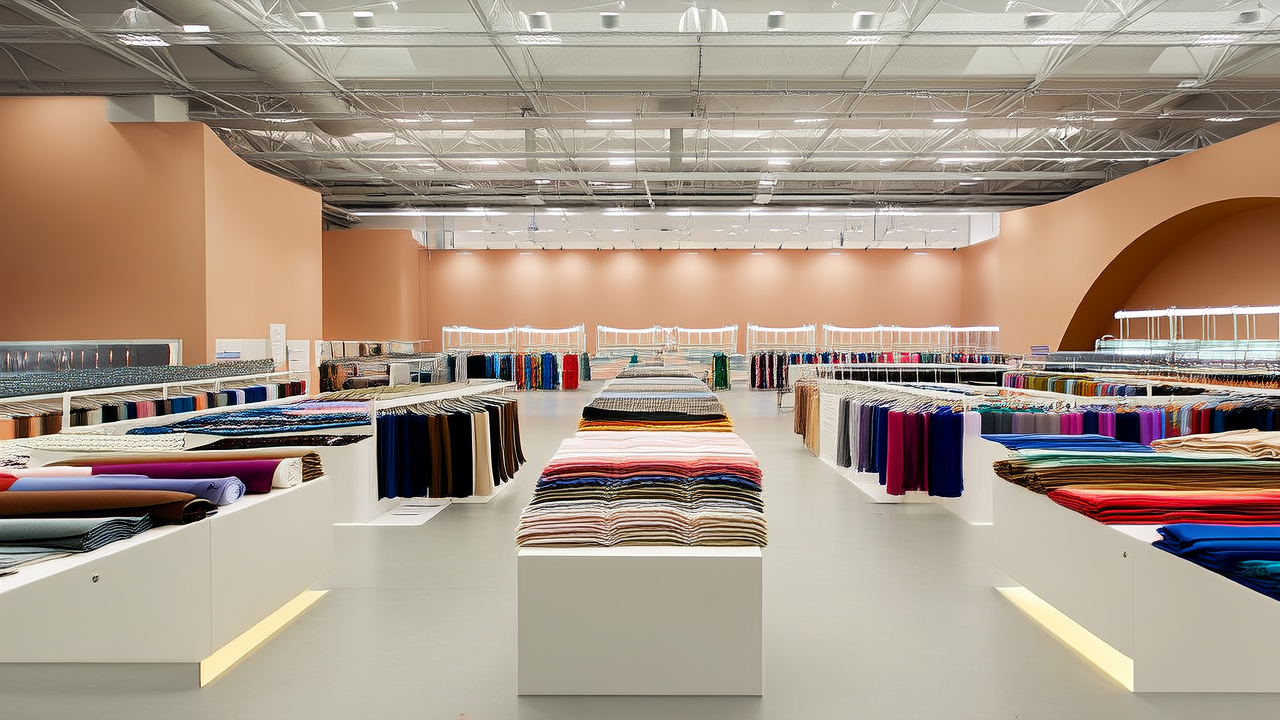
The logic of brand competition is being rewritten. At the 2026 China Textile Brand Innovation Development Training Conference held on May 7 in Keqiao, Shaoxing, a core judgment was repeatedly emphasized: corporate competition is shifting from point-based games to systemic construction. This is not a slogan but an inevitable choice driven by the pressure of the industrial chain. The concurrently opened Keqiao Textile Expo, with over 800 exhibitors covering the entire chain from raw materials, yarn, fabric, design, printing and dyeing to garments, provides the most intuitive footnote for 'full-chain synergy.'
From Scale Advantage to Brand Advantage: Keqiao's Transformation Signal
Keqiao district party committee member Song Qi clearly stated in his speech: promote the textile brand from scale advantage to brand advantage and value advantage. The background of this statement is Keqiao's position as the world's largest textile distribution center—but the scale dividend is shrinking. Data shows that Keqiao is actively trying to transform itself into a hub for innovation achievement transformation and global market expansion by optimizing full-chain services such as brand cultivation, trade matching, and intellectual property protection. This means that the Keqiao model, which previously relied on volume and price competition, is actively seeking to move up the value chain.
China National Textile and Apparel Council president Sun Ruizhe further pointed out the direction of transformation: brands need to find their ecological niche in industrial integration and find their focus in value symbiosis. The three expectations he proposed—emphasizing innovation, improving quality and efficiency, and promoting openness—actually give three paths for brand upgrading: technological innovation to enhance product power, cultural innovation to enrich brand power, and model innovation to expand market power. For buyers, this means that in the future, the screening criteria for suppliers will no longer be just price and delivery time, but systematic synergy capabilities.
Supply Chain Drive: The True Engine of Brand Upgrade
At this training conference, Mao Yongjun, founder of Lushu Zhengcheng and former vice president of Anta Group, gave a key judgment: building a brand is a systematic project, and making a product is a multidisciplinary system. The concept of 'brand-type supply chain' he proposed directly hits the current industry pain point—many brands invest heavily in marketing but suffer from serious departmental silos and synergy gaps in the supply chain.
From a practical perspective, to form a reasonable category mix, leading story selling points, and efficient management processes, brands must break down internal barriers and synchronize the product end with the supply chain end. This is precisely the shortcoming of many small and medium-sized brands and foreign trade factories. For upstream fabric companies, this means simply providing products is no longer enough; they must be able to output supply chain solutions from materials to garments. The case of Fujian Yongrong Jinjiang confirms this—they not only build a differentiated nylon product system but also jointly create label products with brand genes in collaboration with garment and fabric suppliers.
Material Technology: The Underlying Support for Brand Differentiation
Material innovation is becoming an invisible battlefield for brand competition. Duan Furong, head of the Materials Research Institute of Baoxiniao Holdings, shared two core strategies: first, use technological means to inject functions such as machine-washable, cool-touch, and UV protection into traditional fabrics like cotton, linen, silk, and wool, giving classics new life; second, use advanced technology to make chemical fibers show natural fiber texture while retaining the advantages of wrinkle resistance and easy care. This dual-track approach of 'old materials made new' and 'chemical fibers imitating natural' reflects brands' dual pursuit of high cost performance and functionality.
Another track worth paying attention to is the new Hanfu. Niannianyouyu (Zhejiang) Culture Technology Co., Ltd. improves the fabric's silk-like effect and comfort by blending and interweaving fibers such as cotton, linen, silk, Lyocell, and polyester, solving the problems of poor wearing experience and difficult care of traditional Hanfu. Behind this is the new demand from cultural consumption upgrades on the supply chain—brands need not just fabrics, but a combination of cultural narrative and functional experience.
Digitalization and New Media: The 'New Levers' for Brand Growth
Digital tools are moving from optional to standard. Wu Peng, deputy director of the Technology Innovation Center of Dongfang International Venture, pointed out that 3D digital garment software shows strong advantages in development efficiency, production cost control, and sustainable development. Enterprises need to establish a data-based scientific decision-making culture, otherwise they will fall behind in the transformation. For foreign trade companies, this means virtual sampling and remote viewing will become the norm for communicating with overseas customers, not a plus.
Brand building on new media is also upgrading. Yao Weiming, a textile science popularizer, proposed that outputting high-quality content is the core way to form a long-tail effect. He interprets product differentiation selling points from dimensions such as grading indicators, actual experience, and functional direction, emphasizing that 'a good story comes from a deep understanding of knowledge.' The implication for textile enterprises is that brand building cannot rely solely on hard advertising, but must build trust through professional content, turning good products into good commodities.
Practical Recommendations
For Buyers - Prioritize suppliers with full-chain synergy capabilities rather than simply comparing prices. In the future, the core of brand competition will be supply chain efficiency. Whether a supplier can provide an integrated solution from materials to garments will directly affect your product development speed and cost control. - Focus on material technology investment. Fabric companies with functional fiber R&D capabilities can often provide higher added value. When purchasing, ask suppliers for fiber composition, functional indicators, and third-party test reports to avoid 'concept selling points.' - Make good use of exhibition matching opportunities. Full-chain exhibitions like the Keqiao Textile Expo are windows to quickly understand new materials and new processes. It is recommended to prepare a demand list in advance and communicate with exhibitors with specific questions to improve matching efficiency.
For Foreign Trade Enterprises - Accelerate the deployment of digital tools. 3D sampling and virtual showrooms have become basic requirements for overseas customers. It is recommended to complete at least one set of digital product display system within 2026, otherwise you may be at a disadvantage in order competition. - Transform from OEM to ODM. The profit margin of pure OEM is continuously narrowing. Use the material innovation advantages of the domestic supply chain to actively provide design suggestions and material solutions to customers, enhancing bargaining power. - Build knowledge-based content output capabilities. Through professional technical interpretations, application scenario displays, and other content, establish brand awareness on overseas social media. Low-cost, high-professional content is an effective means for small and medium-sized enterprises to break through.
Full-chain synergy is not a slogan but an ultimate requirement for the efficiency of every link in the industrial chain. When uncertainty becomes the norm, only those enterprises that can break through internal barriers and connect external resources have the opportunity to stand firm in the new competitive landscape.