
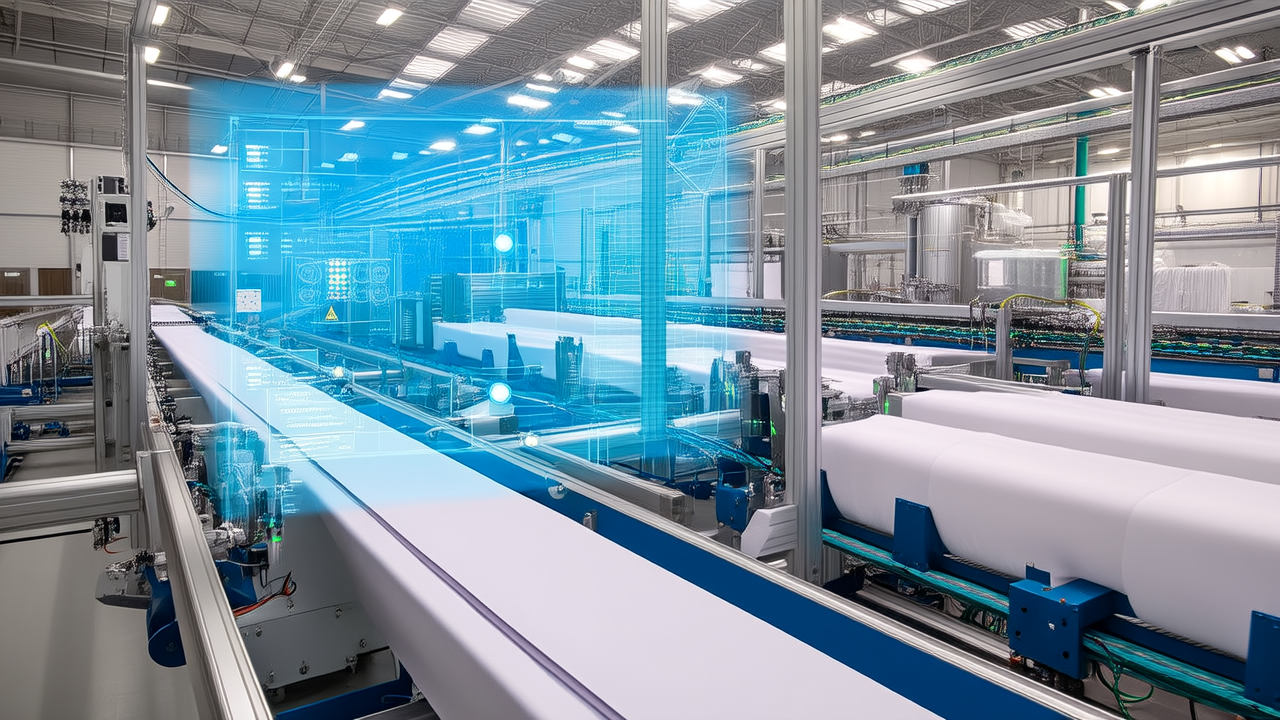
When the textile industry meets artificial intelligence, digitalization has shifted from a 'whether to adopt' discussion to a 'how to implement' race. At the 2026 Textile Industry Digitalization Conference held in Keqiao on May 7, frontline companies from dyeing, fabric inspection, and trade management presented concrete solutions: a dyeing process saving nearly 99% water, self-learning AI inspection systems, and lightweight management platforms for small and medium-sized trading companies. These signals indicate that the industry's digital transformation is entering a scenario-driven deep-water zone.
Background
The conference, themed 'Smart Connect Textile Capital, Digital Create Future,' was attended by Yan Yan, Vice Chairman of the International Textile Manufacturers Federation and Vice President of CNTAC, and Sun Weigang, Deputy Secretary of the Party Working Committee of Keqiao Light Textile City. Yan Yan proposed three major directions for digitalization during the '15th Five-Year Plan' period: promoting deep AI implementation, deepening efficient collaboration across the entire chain, and deeply integrating green manufacturing. Sun Weigang introduced Keqiao's '1+4+N' comprehensive intelligent system and the digital trade landscape of 'live streaming + platform + cross-border e-commerce + overseas warehouses,' showing strong local government support for industrial upgrading. Notably, the conference agenda was very practical—focusing on three core tracks: intelligent dyeing, AI fabric inspection, and full-process digitalization—all targeting 'hard bones' in production and quality inspection, a sharp contrast to past concept-heavy industry events.
Industry Impact
Dyeing: From Cost Center to Order Creation Center
Long Fangsheng, General Manager of Zhejiang Meixinda Textile Printing and Dyeing Technology, proposed a disruptive view: smart factories should not be seen as cost centers but as order creation centers. He shared Meixinda's three-stage evolution path of 'shaping, soul-casting, and intelligence-enabling,' emphasizing that dyeing enterprises must step out of the simple fabric processing position and create incremental value through digital upgrades. This judgment means that for dyeing companies, digital investment is no longer a 'necessary expense' but a competitive barrier for high-value-added orders. More impactful is the TDSD low-carbon digital dyeing process from Hangzhou Huanyu Digital Smart Technology. Using fully self-developed inkjet equipment, new ink materials, and an AI color management system, it achieves a 'spray-and-dye' production model, saving nearly 99% water, reducing carbon by 33%, and cutting chemicals by 21%. For export companies facing green barriers like the EU's Carbon Border Adjustment Mechanism, such technical parameters directly translate into market access qualifications.
Fabric Inspection: From Manual to Self-Learning AI Systems
Traditional manual fabric inspection faces issues like recruitment difficulties, fatigue, and high miss rates. Liu Zhen, General Manager of Shanghai Kaiquan Intelligent Technology, showcased an AI vision technology system whose core is a 'teachable' self-learning system. This means the AI inspector is no longer a fixed detection device but an intelligent terminal that continuously optimizes recognition accuracy by accumulating production line data. Nantong Julian Digital Technology, starting from factory frontline needs, launched a multi-scenario solution covering online defect warning, warp/weft density monitoring, and production anomaly identification, lowering the entry barrier for SMEs. However, Luo Yucheng, Deputy General Manager of Shaoxing Keqiao Weaving and Dyeing Industry Brain Operation Company, acknowledged three major challenges: algorithm adaptation for complex fabrics, system instability in production environments, and high implementation costs for SMEs. This reminds buyers and factories: AI inspection is still in the pilot adaptation stage; companies should prioritize solutions that can interface with existing production management systems to avoid 'digitalization for digitalization's sake.'
Trade Management: Lightweight Path for SME Challenges
For many small and medium-sized textile trading companies, full ERP systems are often too costly and time-consuming to implement. Wang Rong, CEO of Shaoxing Getakesi Light Textile Technology, proposed a 'point-to-area, small-step-fast-run' approach, using low-code platforms to achieve a full-process digital closed loop. This lightweight, iterative path offers a clear judgment: digital transformation doesn't require massive investment; starting from the most painful and data-clearest links can still yield quantifiable efficiency gains. Dr. Hu Song, Director of the China Textile Information Center, further systematized this idea in his report, proposing a five-step digital method: 'diagnose status, select scenarios, supplement data, run pilots, and expand capabilities.' He emphasized that SMEs should adopt low-cost, quick-win paths, while large enterprises should shift from system construction to data ecosystem-driven development.