
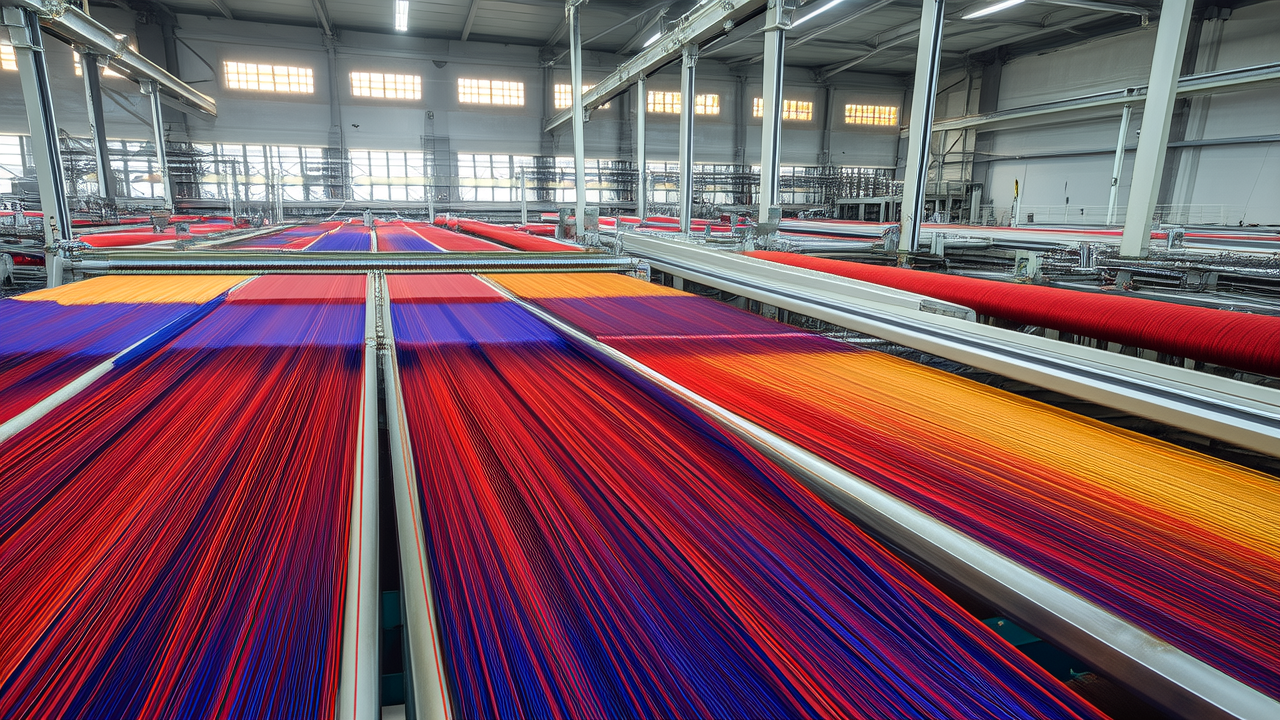
In 2025, Zhejiang's textile industry achieved 1.12 trillion yuan in revenue and exported $95.33 billion, maintaining its national lead. However, this impressive performance did not ease the industry's concerns.
On May 8, 2026, the Zhejiang Textile Industry High-Quality Development Conference, themed 'Co-create, Share, Link the Future,' convened over 200 representatives from government, industry, academia, and research in Shaoxing Keqiao. Held concurrently with the Keqiao Spring Textile Expo, the event served as a collective introspection and strategic recalibration.
Beyond the Numbers: Scale Dividend Peaks, Industry Seeks New Anchor
The 1.12 trillion yuan revenue underscores Zhejiang's irreplaceable position in the global textile supply chain. Yet the prevailing mood was not complacency but deep anxiety about 'what's next.' Zhao Jing, Deputy Director of the Consumer Goods Division of Zhejiang Provincial Department of Economy and Information Technology, acknowledged the industry's resilience while pointing to the future: innovation-driven, digital empowerment, green transformation, and brand leadership—four keywords signaling a departure from the traditional 'scale for survival' model.
China Textile City, the world's largest textile distribution center, now boasts an annual turnover exceeding 440 billion yuan, connecting over 200 countries and regions. Sun Weigang, Deputy Secretary of the Party Working Committee, stated that the market is accelerating its expansion and quality improvement, aiming to upgrade from a 'world-class market' to a 'world-class industrial base and sci-tech innovation platform.' This implies deeper synergy between upstream manufacturing and downstream circulation.
Pain Points: Survival First, Quality Development is Long-Term
The most anticipated session was the 'Entrepreneur Q&A.' Sun Weiting, Chairman of Huafu Fashion, offered a blunt assessment: 'Make more profit in the first half, minimize losses in the second half, and protect cash flow and profit margins throughout the year.' This struck at the core anxiety of textile companies: under the dual pressure of fluctuating external demand and overcapacity, survival quality matters more than scale expansion.
Sun further argued that high-quality development should not be simplistically equated with increased investment, nor should it be measured solely by short-term financials. For the choice between industrial relocation or staying local, his advice was: capable companies should prioritize collaborative expansion into Western developed markets; for domestic investment, rationality must prevail—do not continue trading scale for survival in an oversupplied phase.
This judgment reflects the real dilemma of Zhejiang's textile industry: profit margins in upstream spinning and weaving are squeezed, while downstream brand competition is fierce. The industry no longer needs to 'get bigger' but to 'get better.'
Organizational Evolution: Associations, Media, and Academia Build a New Ecosystem
Beyond strategic discussions, the conference sent clear signals at the organizational level. The Zhejiang Textile Industry Association signed a strategic cooperation agreement with Textile & Apparel Weekly, covering omnimedia promotion, content co-creation, joint events, and collaborative research. This is not just a media partnership but a reinforcement of the industry's think tank function—in an era of information fragmentation, a content platform integrating trend analysis, policy interpretation, and practical cases is invaluable for SMEs.
More notably, the Zhejiang Textile Engineering Society and the industry association signed an agreement to co-build six professional committees covering fiber materials, spinning technology, weaving, home textiles, textile machinery and smart manufacturing, and sustainable development. The collaboration of two 5A-level social organizations aims to bridge the gap between 'academic research depth' and 'industrial organization breadth.' This mechanism is expected to align R&D more closely with frontline pain points.
Practical Samples: Functional Masterbatch, Smart Manufacturing, Credit System as Three Levers
Three directions were highlighted in the special reports: functional masterbatch as a material innovation breakthrough, smart manufacturing as a core tool for cost reduction and efficiency, and credit management as the underlying guarantee for supply chain stability.
Zhejiang Jincai New Materials shared how functional masterbatch enhances fabric added value; Huansi Wisdom Technology presented a practical roadmap for digital transformation—focusing on data-driven scheduling, inventory reduction, and yield improvement, rather than abstract 'Industry 4.0' talk. Zhejiang Haotian Credit Management proposed a supply chain finance and credit system framework.
Seven frontline representatives—from Jiren New Materials' circular recycling, Guxiandao's green fibers, to Lantianhai Textile's protective fabrics and Xinlan Textile's digital transformation—showcased breakthrough practices in their niches. The common thread: pursuing excellence and specialization within a specific domain, not maximum scale.