
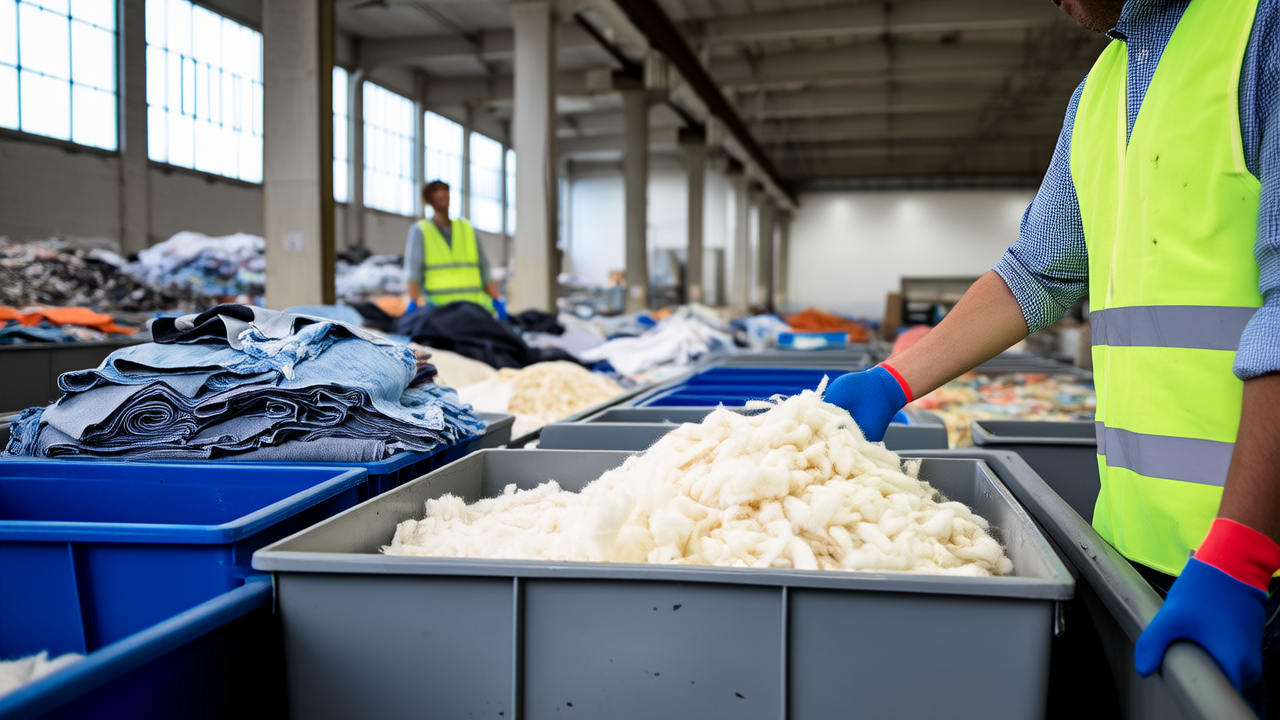
The fashion industry's circular economy rhetoric has been loud for years, but the commercialization of recycled fibers remains stuck in a 'good idea, bad business' limbo. At the just-concluded Global Fashion Summit, experts bluntly stated that without mandatory regulation and substantial investment, textile recycling will struggle to break out of small-scale pilot projects.
The core contradiction lies in production costs: high-quality mechanically recycled cotton is 30% to 50% more expensive than virgin cotton, while chemically recycled polyester costs more than double virgin polyester. Brands are price-sensitive, and procurement departments are unwilling to pay a 'green premium' without clear demand signals.
Cost vs. Quality Trade-off
The challenge is not technical but economic. Mechanical recycling shortens fiber length and reduces strength, making it unsuitable for high-end fabrics. Chemical recycling preserves quality but is energy-intensive, with high solvent recovery costs. This creates a chicken-and-egg loop: brands want stable, competitively priced recycled yarns, but recyclers cannot scale because orders are too small to amortize fixed investments.
Chinese customs data shows that export prices of recycled polyester staple fiber have hovered between $1.2 and $1.5 per kg over the past three years, consistently above the $0.8 to $1.0 per kg range for virgin polyester. The price gap remains the biggest barrier to adoption.
Policy and Investment: The Twin Engines
Experts at the summit agreed that scaling requires external push. The EU's proposed Ecodesign for Sustainable Products Regulation and the extended producer responsibility scheme for textiles would mandate a minimum percentage of recycled content in garments. This top-down regulation would create hard demand.
On the capital side, at least 15 textile recycling startups globally have closed Series B or C rounds in the past 18 months, cumulatively raising over $800 million. Funds are flowing into industrial-scale chemical recycling trials and automated sorting equipment.
Ripple Effects on Industrial Clusters
For China's textile clusters, the circularity push is both a challenge and an opportunity. In Keqiao and Shengze, the capacity utilization rate for recycled polyester filament is only 50-60%, far below the 80%+ for virgin polyester. Mills are hesitant to expand without guaranteed orders from downstream apparel brands.
However, Nantong's home textile cluster has piloted a closed-loop model: used garments → opening → spinning → weaving. Some local producers, by signing long-term offtake agreements with international brands, have stabilized recycled yarn utilization above 70%, proving that technology is mature when demand is steady.